Why farmpunk?

A farmpunk could be described as a neo-agrarian who approaches [agri]culture, community development and/or design with an anarchistic hacker ethos. "Cyber-agrarian" could supplant neo-agrarian, indicating a back-to-the-land perspective that stands apart from past movements because it is heavily informed by conceptual integration in a post-industrial information society (thus "forward to the land" perhaps?) The art and science of modern ecological design—and ultimately, adapting to post-collapse contexts—will be best achieved through the combined arts of cybermancy and geomancy; an embrace of myth and ritual as eco-technologies. In other words: the old ways of bushcraft and woodlore can be combined with modern technoscience (merely another form of lore) in open and decentralized ways that go beyond pure anarcho-primitivism. This blog is an example of just that. Throughout, natural ecologies must be seen as the original cybernetic systems.

**What we call for at the farmpunk headquarters**
°Freedom of information
°Ground-up action + top-down perspectives
°Local agricultural systems (adhering to permaculture/biodynamic principles) as the nuclei of economies
°Bioregional autonomy
°Computers are optional but can be used for good—see peer to peer tech, social media for direct popular management of natural or political disasters (e.g. Arab Spring), or the mission of the hacker collective Anonymous
°You

Monday, March 7, 2016

Emotional Relationships With Nature

Note: I'm cross-posting this from the blog at my friend's website The River's Path, where I'm a new contributor.
If you are reading this, you might be familiar with the fruits of a personal connection to nature —nourished by the memory of a tree or a river from your childhood, or the birds or deer that regularly pass through your backyard. Even if you move or travel frequently, perhaps there is some omnipresent element of the natural world that can ground you wherever you are—for me it is the feeling of the sun on my face, or a view of the vast stellar clockwork of the night sky turning around the still  point of the North Star. These encounters remind me that wherever I go I am held by ever-greater concentric circles of being. Being “friends” with particular plants or hills or rivers, or with sunshine or starlight, by which I mean loving them and on some level needing them, have been part of my experience of “home.” And when I haven’t felt at home, at least my experience of the home of my body.
The emotional and spiritual value of the natural world is hard for our culture to quantify, hard to monetize and market, but that doesn’t mean that it is superfluous. Actually, it is often an unacknowledged facet of what we consider sacred, special, safe, novel, or memorable. Personal relationships to elements of the natural world are much more emotional—characterized by affection, awe, or nostalgia—than they are abstract or intellectual. They are friendships, kinships. There was a time when I might have thought that these sorts of relationships were restricted to childhood. But today I am more and more convinced that they are also the domain of adulthood—at least, the kind of adulthood I want to inhabit.
A beloved white birch at my grandparents' former home in Vermont's Green Mountains
A beloved white birch at my grandparents’ former home in Vermont’s Green Mountains.

My time as both student and instructor in the fields of nature education and nature-connection has begun to teach me many useful things—how to make fire-by-friction, how to identify edible and medicinal plants, or how to track and trail wild animals. But the most important (and humbling) lesson impressed upon me has not been something new, not a skill or a bit of information, but a reminder of something old: the validation of the emotional richness of my experiences in the outdoors and with animals—experiences that never seemed to fit comfortably in any readily accessible interpretation of the world.

The feel of the northern hardwood forests of Vermont where I grew up, the smell of my family’s orange tabby cat, or the sight of a herd of sheep grazing in a field, are fundamental to my personhood in ways that seem to upend and subvert what I’ve been taught about being a person. Perhaps it is because these things are fundamental not just to ‘who’ I am, but ‘what’ I am. In an era brimming with political and social identities, certain labels, though powerful in their own right, still can only take me so far in such a quest. Indeed, such affiliations help answer who I am within the human world, but not what I am by virtue of my relationships to the non-human world. By these latter measures I am an acquaintance of maple trees, a creature that cuddles with cats, a guardian of sheep, and sometimes more, sometimes less. In this realm, one communicates simply by being, by moving, by looking. In this realm, one is simply a friend of things, or an eater of things, or, occasionally, food for things. One is a creature.
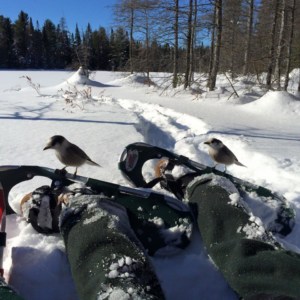
Gray Jays, one of the north country's most charming solicitors of treats, visiting my spouse and me in Algonquin Provincial Park.
Gray Jays—one of the north country’s most charming solicitors of treats—visiting my spouse and me in Algonquin Provincial Park.
I have found that I cannot know this creature-hood merely by relating with other humans. I can only know it by also relating with non-humans—with landscapes, animals, tracks, fire, with bone and wood—as well as with humans. It is balanced on this edge, where relationships with both human society and non-human society can be mutually cultivated, where I have felt a deep kind of belonging take root in my heart—an enigmatic feeling of being hugged by two very different parent-worlds that nonetheless are fated to intertwine through me. I want ardently for this medicine to be available to anyone whom it might help, which is one reason I work as a nature educator and guide. Teaching wilderness survival skills is an awesome perk for me, but I also am an advocate for a more surreptitious survival skill: cultivating relationship with as many parts of one’s surrounding ecology as possible in as many ways as possible. Even if we don’t need these “survival skills” for our bodies, we might need them for our souls.

There are many ways to relate to a tree, for example—you might sit in its shade with your back against its trunk, or climb it to look at something far away. How is its wood for carving? For fire? Is any part of it edible—its leaves or its inner bark? How might you find out such a thing? Could you make clothing or medicine from it? Maybe! What animals use this tree for food or shelter? What birds does it attract? On a slightly different note, what does this tree mean to you? Maybe you built a fort in this tree, buried your family pet under this tree, or cut your wedding cake under this tree. Maybe this tree has witnessed something monumental.

Do trees in general symbolize anything to you, and why? And what might this tree—or trees in general—signify to your ancestors, within their mythology or their livelihood? What about to the people who are indigenous to this land? What if the people indigenous to this land say that their ancestors were actually born from this tree? If this is a common tree in this area chances are it was (and is) very sacred, very useful, to someone—certainly an animal, but also a human, even maybe an entire culture. This is indeed an unwritten rule of human ecology. Is there a way you could honor this tree or thank it? If the last question seems to be getting into cryptic or far-fetched territory, I get it. But believe me, if you learn all the other things about the tree, you might actually really want to thank it.
A physical ode to the white birch, ethereal denizens of our northern forests. From top left: Chaga, a medicinal fungus that grows inside birch trees, highly prized by northern latitude peoples; a utensil carved from birch wood; birch bark baskets made at Roots School in VT; the beginning of a friction-fire bow drill kit made with white birch.
My ode to the white birch, ethereal denizens of our northern forests. From top left: Chaga, a medicinal fungus that grows inside birch trees, highly prized by northern latitude peoples; a utensil carved from birch wood; birch bark baskets made at Roots School in VT; the beginning of a bow drill fire kit made with white birch.
One could call such multifaceted connections—ones that inspire praise and thanksgiving—spiritual. I do, though this term may not work for everybody. Whether you choose to look at them as spiritual, emotional, or both, there is an undoubtedly numinous nature to such relationships, as there is to any close human bond. There is a feeling of empathy, of togetherness and community, yet at the same time a mystery, something coy and esoteric—the allurement of undeniable difference. There lies the magic, the potency, and the deeply transformative nature of relationship and our human capacity to relate. If we can recognize (and name) that we have the ability to relate to plants, animals, and landscapes in a more interpersonal way—the way we relate to a beloved family member, a pet, or a dream—we can shift our center of gravity in remarkable ways. We can, perhaps, feel even more at home in the world than we thought possible.

As this shift takes place it is imperative for us to humble ourselves with the fact that relating to nature in emotional and social ways wasn’t invented yesterday—this is the well-trodden territory of shamanistic and animistic cultures the world over. It would be much more accurate to say that relating to nature in these ways ‘invented us.’ Certainly, we are alive today because our ancestors intimately knew the natural world, both in a utilitarian sense and in a spiritual sense. Those things, I think, used to be intertwined…it is only some modern cultures that parse them out and see them as different, for better or worse.

It is no coincidence that many nature-based cultures consider their environment populated with legions of spirits and forces that are stewards and shepherds of nature, of the elements, of the turning of the earth and the movement of the clouds, or that they consider non-human animals or trees as persons—as beings with a soul. Relationships with these beings became personal, intimate, emotional, and social—not because someone thought it was a hip idea or because it made theoretical sense, but because of the demands of living in a world that was both ever shifting yet in certain aspects stayed the same. In a subsistence life where so much is uncertain, one does well to get to know one’s neighbors, and to duly honor them. Some day—or maybe even most days—our lives might depend on them.
Some natural objects that decorate my living room, reminding me of the beings that silently support us.
Some natural objects that decorate my living room, reminding me of just a few of the beings that silently support us. 

Tuesday, May 19, 2015

Michael Meade: "It Takes More Than a Village"

An entry for modern humans in an alien's field guide to earth would be incomplete without noting the centrality of meaning and symbols to our lives and behaviors. The struggle to find empowering meaning (and perhaps eradicate corrupted meaning) marks us all, but regardless of the intensity of the pain it may bring, the importance of meaning itself is never nullified (even if we periodically declare it is), but highlighted, perhaps never more than by nihilism itself. What is quoted and linked to below is an under-represented angle on the current socio-political atmosphere by Vietnam vet, mythologist, and youth mentor Michael Meade. This guy is a true elder!

He has an amazing ability to be holistic and not divisive in his language. At the same time, he doesn't unite his readers to the point where their unique identities are erased and subsumed under one "hero's journey." Meade is not the "Joseph Campbell" that the academy loves to depose. (I often wonder if even the actual Joseph Campbell was that "Joseph Campbell" XD)

"A society is playing with fire each time it rejects the innate nobility of its youth. Youth not only carry within them the dream of the future; they also tend to act out the imbalances and injustices of society as well as the deep grievances of their communities. Injustices that are not faced inside a culture will eventually be lived out on its streets as a kind of fate." - Meade
Read the rest of his commentary here.

Wednesday, March 11, 2015

Upcoming Queer Fast with the School of Lost Borders

It is difficult to express how blessed I feel to have the opportunity for my first ceremonial fast to be within an intentionally queer/LGBTQ community of questers this June, on the literal eve of my 30th birthday. Doing a fast with the School of Lost Borders brings together two of my passions: nature-connection and rites-of-passage work. Both of these interests are inspired by my experience of these things as a queer person, and my longing to be able to share these elements of a resilient and healthy culture with queer folk and many others. 
One thing I’ve told myself is that the "queer" part of me is “the secret face of my connection to Creator.” I became interested in mysticism in my early teen years and it’s been such an integral part of who I am since then. My longings to connect to the realms of spirit and soul seem to be interwoven with my queer identity, which is really more of an “unfolding” than something that can be identified and quantified. Put another way, the unfolding of my queerness seems to be simultaneously an expression of soul (unique, organic, and personal) and also a means for connecting with spirit—with the transpersonal and cosmic. Being genderqueer was something I became aware of, on a sub-conscious level, when I was 7 or 8 years old, long before sexuality was something I thought about. Gender, which I understand in part as the interplay of masculine and feminine energies within me and around me, seems deeply coupled with that enigmatic concept folks call “soul,” as a pattern mysteriously emerging from the cosmos through me, and it is an inevitable mediator in how I relate to the world and to other beings.
I earned my Bachelor’s and Master’s degrees in Religious Studies, focusing on the Judeo-Christian tradition. These traditions hold a lot of cultural trauma and ancestral grief, but also offer powerful connections to ancestors, and with that potential for healing and reclaiming parts of “Western” mythic consciousness. Nature-based and contemplative aspects of these traditions especially interest me as those have been largely lost in mainstream American Christianity. Although I was raised agnostic and non-theist, a big part of my draw to Christianity is to the devotion to Mary in my Greek matrilineal ancestry. To me, Mary is an underworld guide (a role that could also be known as “psychopomp” or “bodhisattva”) and represents perhaps the last vestiges of an archetype for “soul” in Christian tradition. One of my intentions in my fast is to continue a conversation that I began to discover the threads of last year; to delve deeper into my relationship with her as a guide and ally in my journey as a queer mystic, and to step outside of the comfort zone of merely knowing her in an intellectual sense (through scholarship).
My main intention though with this fast is to mark a passage into initiation as a mentor, educator, and cultural transformer who is genderqueer, someone who stands as a “star” person, a vital space in between the moon (feminine) and the sun (masculine) beings. Almost five years ago now, I came out as transgender and started hormone therapy to become more masculinized. However at the time of my coming out, I was in a long-term relationship where the pressure to be “heteronormative” was absolutely crushing. Though my former partner was fascinated by and supportive of my journeys in the realm of gender, the pressure and tension created by our very different upbringings and social circles had me trying to fit myself into a ‘male’ identity. It didn’t feel right. And truly, it was me who was my own greatest judge during that time. Slowly, I figured out how to get out of my own way and chose to hear the message that had long been there: that my androgyny (the androgyny of my soul as well as the androgyny that is visible to others) is a gift and is holy, not something that needs to be cured. There aren’t social roles or archetypes in Western culture for the possibilities of genderqueer personhood, but that does not mean that these possibilities don’t exist. Today, I’m still on testosterone therapy, though I’m on a low dosage that upholds, externally, the interplay of masculine and feminine that I feel inside.
Last year, only about 8 months after my former finance and I—with great difficulty—ended our engagement, I had the privilege of participating in a sunrise ceremony led by a Chumash elder in Southern California. I was among a group of about 30 people and the elder had been informed by our group leaders that there was a transgender person in the group, since part of the ceremony involved dividing the men and women into two different groups. When the time came to divide us in that way, I wasn’t sure where to stand, so I stood with the men. The Chumash man came up to me and gently led me to a place where I stood alone, at the head of the two lines of groups, (men and women) that were facing each other. Then, as he directed the groups to arrange themselves in a circle around the ceremonial fire, he asked me to hold his can of tobacco and stand at the place where everyone was filing into the circle. I was honored to assist him. Later, he met with the men and the women in the group separately, but allowed me to attend both meetings. He then publicly called me out in honor of the medicine I carried as a bridge between those worlds. I had never been treated like this before, especially not from a respected male elder and community leader. It did not feel like he was tokenizing me at all or excluding me from either world—he actually saw me how I saw myself, not as an “exile” or “rebel” from the gender-binary, but as someone who deeply empathized with the cultural wounding around gender and wanted to hold space for healing using the gift of shape-shifting and manifesting connection.
I see all humans as shape-shifters, ecologically speaking, but queer folks of many varieties (not just gender-queer folks) hold a unique sub-niche within that: we are able to access an innate understanding of shape-shifting that is rapidly being lost in the modern world.
In this year since the sunrise ceremony, I often think about the Chumash wisdom keeper and have such immense gratitude that I don’t know what to do with it. I feel so humbled, and also responsible for the important role that he seemed to naturally and effortlessly see me as occupying. It is hard to hide, to feel “unseen,” now, if it ever was easy before. For months I wondered, should I write to him and ask if I could learn more from him about how to hold that space that I caught a glimpse of? Do I dare ask that? I wonder, as a “Connector,” and someone who empathizes deeply with the struggles of the masculine and the feminine, how can I be a model of empathy when I still have so much unlearning of destructive emotional patterns to complete? I struggle to feel worthy in the realm of the heart, because I worry that I have not paid enough attention to its intense longing, and instead cultivated the intellect too strongly. I struggle to sing out loud and to enact the spontaneous ceremonies that my heart imagines. Confronting these fears seems connected to the ability to fully embrace what I’m capable of. At this time I cannot crystallize all of the above questions into one single question, and I’m not sure if that is exactly what is called for since in the realm of the vision fast, one has to be careful about posing questions to Mystery that are “too specific.” It feels like I am gathering important tools that I’ve gained in the last year and a half (in which my ego has been through a few proverbial blenders) and arranging them together, aligning them to see what they evoke, how they ask to be used in this world...
Thanks for reading, and for holding space for this quest if it moves you.

Saturday, March 7, 2015

Indigenous Notions of Land Stewardship

A biocentric model of environmentalism that sees humans as alien or foreign to wilderness (mere visitors) is merely the extreme opposite of an anthropocentric model that chauvinistically sees humans as lords of nature. Both are unbalanced and the former is not a sustainable cure for the latter, more like just a temporary immune reaction at best.
“In wilderness preservation, in land management, forestry, and resource management of all kinds, Native Peoples offer a kind of model. But it’s not the biocentric model that you’re familiar with from deep ecology or Aldo Leopold’s land ethic. It’s fundamentally different because it’s primarily kincentric. That’s the word that I have coined to describe a unique Indigenous cosmology and relationship to nature. It’s not in the dictionary. I had to think of something that would work to explain that what this relationship is about in the universe is one of equality. Humans don’t even have the moral authority to extend ethics to the land community, as the Leopold land ethic and deep ecology would do.

Traditionally, we work with animals and plants. We are comanagers with animals and plants. We don’t have the right to extend anything. What we have the right to do is to make our case, as human beings, to the natural world. That compact, that kind of contract between animals and human beings, is what has guided Indians’ subsistent livelihoods—hunting and gathering—and Indian agroecology and agriculture in the world for a very, very long time.” — Dennis Martinez, Original Instructions: Indigenous Teachings for a Sustainable Future, pp. 89-90.
Yesyesyesyesyouaresoright. Reminds me of Murray Bookchin’s work (particularly the article on social ecology versus deep ecology). Deep ecology, which has a history of being considered sexy by left wing radicals, (bless our hearts) was rooted in an elite sector of Euro-American academia representing a very narrow demographic. I must quote Bookchin, curmudgeon-sage that he is: 
“Does it make sense, for example, to counterpose deep ecology with superficial ecology, as though the word ecology were applicable to everything that involves environmental issues? Given this mindless use of ecology to describe anything of a biospheric nature, does it not completely degrade the rich meaning of the word ecology to append words like shallow and deep to it—-adjectives that may be more applicable to gauging the depth of a cesspool than the depth of ideas? Arne Naess, the pontiff of deep ecology, who inflicted this vocabulary upon us, together with George Sessions and Bill Devall, who have been marketing it out of Ecotopia, have taken a pregnant word—-ecology—-and deprived it of any inner meaning and integrity by designating the most pedestrian environmentalists as ecologists, albeit shallow ones, in contrast to their notion of deep.

This is not mere wordplay. It tells us something about the mindset that exists among these “deep” thinkers. To parody the words shallow and deep ecology is to show not only the absurdity of this vocabulary but to reveal the superficiality of its inventors. Is there perhaps a deeper ecology than deep ecology? What is the deepest ecology of all that gives ecology its full due as a philosophy, sensibility, ethics, and movement for social change?”

Tuesday, February 3, 2015

My Next Horizon: Excavating the Nature-Based Roots of Christianity


What I'm currently working on: The "Good Shepherd" from the Roman catacomb of Priscilla, c. 3rd century C.E., where some of the earliest known Christian art was found. The Good Shepherd functioned as an early metaphor for Jesus, but this archetype of the herdsmen with shamanic powers can be traced in the story-traditions of figures such as Orpheus, Hermes, Moses, King David, or Endymion the shepherd-astronomer. Indeed, to think such a rich web of meaning discredits the story of Jesus is to miss the point entirely--in the mode of myth such things just compound potency and make things more interesting. I believe the figure of the Shepherd is central to the cultural "creation story" of the Near East, hence Western culture. Shepherd is a symbol of underworld guide (guide of souls), but is also an icon of ecological "deep" history, speaking of a symbiotic relationship between two species that literally made our culture possible. We westerners seem to romanticize such symbiosis in other cultures, especially pre-industrial ones, but fail to see a comparable pattern in our own. Mythology should not be just for talking about other people's cultures and distancing ourselves from the past. I know that religious studies as an institution felt tarnished by the "crypto-theological" work of certain mythologists. But there can be a way to take note from both the universality of mythology and the relativism of postmodern thought. The notion that you have to pick one (and they are just stand ins for the old dichotomy of rational/intuitive, intelligence/emotions, science/art) is the symptom of an emotionally wounded and indecisive culture that, tragically, can't trust itself.

Queering the Sciences: A middle road between Postmodern Thought and Scientism?

This post is somewhat dated (two or three years old to date, perhaps) but I'd like to publish it since it is more or less complete and has been saved as a draft for quite a long time now.

There has been created in American intellectual (and pop) culture a sort of postmodernism on steroids that is somewhat of a Frankenstein. I have been influenced very positively by postmodern thought and critical theory myself, and I certainly believe there is a proper place for it in the methodological toolbox. But there are ways in which postmodern thought has gotten "out of hand" and I think threatens to create an atmosphere of moral nihilism that ironically isn't too dissimilar to the spiritual nihilism that postmodern theologians criticize scientists for. Simply put, the goal of postmodern theory/critique is deconstruction, and as such it is a provisional lens, a necessary perspective along the path to wisdom. But it cannot be used by itself, it is auxiliary. It should not eradicate all possibility of subjective construction and creation of meaning toward some perceived (and naturally culturally constrained) goal. And it should not ignore or devalue the functional realities of meaning-making. Because if we are not careful it will destroy all myth, including the benign, even enchanting ones we hold about ourselves, that help us navigate through life.

There is also a worrying bifurcation occurring at this moment in Western culture.
As academic discourses reach new heights of abstraction and linguistic focus, popular culture becomes more and more visual. But the worst ethical ramifications of postmodern thought trickle through to find validation within a consumer culture. The worst notion by far is the one in which there is no universal morality, corresponding to the notion that there are no overarching truths. And if there are, the thinking goes, it is dangerous to calibrate one's moral compass by them, lest one be disappointed and stepped on by an increasingly immoral and disenchanted world.

The anarcho-primitivist John Zerzan dishes out a blistering critique of it as he sees it:

So Postmodernism reveals that autonomy has largely been a myth and cherished ideals of mastery and will are similarly misguided. But if we are promised herewith a new and serious attempt at demystifying authority, concealed behind the guises of a bourgeois humanist "freedom", we actually get a dispersal of the subject so radical as to render it impotent, even nonexistent, as any kind of agent at all. Who or what is left to achieve a liberation, or is that just one more pipe dream?

I think that postmodern thought can be reconciled with cognitive science and evolutionary psychology. Both areas of inquiry contain great truths that should be synergized, but ironically they can also both be used to discredit each other.

Here are my thoughts on this matter.

Don't throw the baby out with the bathwater. There is an interesting moral problem here to be solved. Like many other humanities students I have been at times very concerned about the attitude of scientific imperialism, and the on-the-ground politics and machinations within scientific research. I think that there have also been significant stumbling blocks in many branches of science—such as neuro and cognitive sciences, as well as ecology and economics—that have led to frameworks of extreme reductionism, atomism and determinism, not to mention a sort of spiritual nihilism that is more or less socially useless and at best a desperate counterweight measure for anti-scientific and anti-intellectual sentiment. This can make some scientific discourse seem polemical and reactionary, which is of course not very intellectually seductive.

Postmodern principles are essential for compassionately navigating, and being open to, a pluralized, globalized world because they caution against moral, ethical and social truth-claims, and they provide radical ways of re-conceptualizing identity and personhood, and the ways in which culture constructs things that otherwise seem very fixed to us subjectively. Postmodernism is also pivotal in deconstructing the cultural and social processes through which any meaning is made, not just that which is pertinent to identity.

But all the same, postmodernism is not some form of logic that you can blindly apply to every issue you encounter. As the internet meme quips, "You must be new here..."

Naturally, universalist claims—such as some made by the scientific studies of human brains and behavior—are called into question because clearly our world-views and belief systems are self-supporting, and there's no way we can step outside of our cultural embeddedness to gain a total vision of humanity... I agree that such a bird's eye view does not exist. I can see that it probably seems to many that scientists arrogantly claim to be perched atop just such a vantage point.

But this is where a truth of this intellectual battle comes out. Maybe such arrogance and lack of empathy is a social problem, located in individual people, and not inherent in the ethics of science or the scientific method. Or, if such attitudes ARE somehow vestigal in science, remnants of a white supremacist, colonial past, they CAN be disconnected and discarded, with some work. Just the same, the benefits of science can be disembedded from certain histories of use.

I'm annoyed that those who take PM to its (illogical) conclusions often think that they are the ones whose worldviews most closely resemble one free of presuppositions and biases. This is a form of elitism that is a mirror image of what it criticizes in scientism.

The truth, as usual I think is somewhere in the middle.

Many historians and humanities scholars have a problem with the theory, central to cognitive science of religion (for example) that since brains, being products of a common evolutionary past, are common to all humans there must exist universal constraints to behavior delineated by biology. And that biology is in fact very important in understanding culture, and engaging in a true comparative study of human cultures.

Now, these days many scholars in the humanities, especially religion, are very wary of comparativism because of the ostensibly discredited (as culturally biased) work of the likes of Mircea Eliade and Joseph Campbell. For many, the only safe thing to do is to study one thing, and the whole notion of comparing different religious behaviors, myths or symbols in service of an idea (or ideal) of a universal and perennial human spirituality is deeply problematic, and I've even heard it called "crypto-theology" (Which I guess is an insult) I get where they are coming from, but personally I think Eliade and Campbell were onto something.

Cognitive science entered the humanities scene in the past decade, and I think it has billed itself as the "new comparativism", replacing Eliade's idea of a universal human desire for a return to one's origins with the architecture of the brain and the lasting legacy of our evolutionary past, that is literally inscribed into our flesh. And as such it has been particularly threatening to postmodern ways of thinking about culture, society and gender. But yet, I think that neuroscience has come to some of the same conclusions as Eliade, as evident in Andrew Newberg's research and the related field of neurotheology on how we are neurologically predisposed to mysticism and magical thinking. Moreover, such beliefs may not just be large scale hallucinations, "opiates of the masses" or "delusions", but might actually have beneficial effects, regardless of whether their symbolic content is "true" or not (and indeed, I think spiritual and mythic realities really destabilize the rational, scientific Western ideal of "truth—as one scholar puts it myth is in fact a cosmological theorem). Such beneficial effects may operate on many scales, from individual physiology to group solidarity and even beyond. Notably, Newberg's works include a book about the various neurological (and physiological) benefits of religious belief and/or practice.

That said, eventually I hope that the discussion about religion, or for that matter any other human cultural behavior, will turn to something beyond "benefits" and "detriments" to the individual self—as if we were all hanging out in the self-help section of the bookstore—and will expand into a more dispassionate (yet more empathic) discussion about ecological dynamics.

Personally, I think Postmodernism, against claims to the contrary, does make its own universalist claim, one that is I think not so different from the claim about the universal explanatory power of cognitive science.

For PM the grand organizing factor, the one responsible for the development and learning of every human being... is culture. It is once the universal constant and the universal variant.

But "culture," whatever that is, and the brain with its hallmark process we call "mind" are partners in crime, co-creators of human life on earth. They are intimately coupled, self-regulating relational processes, one [the brain/mind] flesh-and-blood, bound to the wheel of time, and the other [culture] the handmaid of the flesh, the symbolic order that has one foot outside of time, while another stays firmly rooted in the temporal world.

You just can't pick one in lieu of the other to use as a critical lens—they are both equally responsible, important and real, though real in very different ways.

I suspect that through inter-theoretic reduction and transdisciplinary work, postmodern thought and evolutionary and brain sciences can be reconciled. They do need each other, or something like each other, because the brain sciences are too chauvinistic and PM theories are in too much of a perpetual existential crisis.


Sunday, August 25, 2013

The Habit of Body Art

I spent a month at an Orthodox Monastery in Greece this summer, volunteering on their farm.

The monastery was perched high on the slope of Mt. Kissavos at around 3,500 feet, which is in the Northern Central portion of Greece, near the port of Volos and with Mt. Olympus to the North. The monastery, populated by nuns and novices from many countries, was about 3 kilometers from the small village of Anatoli, a small cluster of white houses with terra cotta roofs hugging the mountainside. Their mountain rose out of flat alluvial plans below that stretched far to the West. The city of Larissa was in the midst of these plains, surrounded by cultivated land. Even here among the more industrial-scale farmlands, the ever-resourceful shepherds would take their flocks to glean the fields after the grass and grain harvests—things ancient and modern overlapping in a strange symbiosis. From up on the mountain at night, the summer atmosphere refracts the city lights of Larissa, which shimmer thousands of feet below the dark, Oak-shrouded balconies of the monastery. It almost felt like we were on a spaceship slowly orbiting earth. On a clear day we could also see the Aegean to the East, through the trees. Dry aromatic scrub blanketed the land, punctuated with stands of old oaks and little spruces. It was just a few hundred feet too high for the olive, lemon, and fig trees that Greece is known for, but the the air still had that hot herbal smell at mid-day. A few times a day you could hear the whoop of shepherds echoing across the hillsides, as well as the sweet clang of bells and the baaing of the foraging flocks. Sometimes we would meet them on the road to town, somehow both chaotic and organized as they flowed en masse behind their herder and around the slowly creeping automobiles. Foxes, hare, and wild boar roamed the woods, elusive, but leaving their tracks for me in ephemeral patches of mud that appeared after the rare alpine thunderstorms.

My soul feels deeply connected to that land, and to the anarchistic traditions of herding and keeping animals in rural Greece. Gates open, Horses standing aimlessly in the roads. Little sheep poops scattered across the paved roads like marbles. They seemed like sentinels that stood for the arbitrariness of borders, of property lines.

I remembered being in the Arab quarter of the Israeli city of Akko the previous summer. As I walked at night along the sidewalk of a cobblestone city street, with little cars jammed in any possible parking space, a young boy riding a pony bare-back galloped past me. The feeling came again. The strange poetry of the rustic and the modern, together. Westerners divide these things into new and old, dark and light. But really there are no such distinctions.

One sister in particular I became soul-friends with. One of the last days I was there she and I had a deep conversation in which she asked me directly and with curiosity what my tattoos and piercings meant. I was cleaning beets that I'd just dug up, cutting the tops and taproots off with a paring knife, and they were so incredibly red, almost neon in the darkening light of dusk. My body art had come up a few times before but I had always been at a loss for words. Now after working alongside me for several weeks I felt confident that my creaturely presence had articulated many things that words could not, paving the way for what I was about to say. I knew it was important, this conversation, and I had a feeling what I said would get back to the Abbess, for indeed they were all curious about this question, but not all had as much time to spend with the volunteers as this nun did. I had thought about how to speak to this Sister in a language she could understand. This was the language of devotion, of piety, of sacrifice, and also a language of love, of a sacred madness that I felt deeply resonate within me. I knew they were in love, here, even though they seemed so at peace, there was still something fiery beneath it, in a way enabling and creating the ecology of tranquility and synergy that outsiders witnessed. I could feel this being-in-love, and they did not deny it. This sister had told me that when she saw Orthodox monastics for the first time as a 20-something Lutheran in Germany, it was just like falling in love. "They had something, I did not know what. I wanted to find, what is this thing?" she explained in the sort of delightful, concise English that you can expect from someone of a foreign tongue. From then on her course was set towards that embodiment that she had glimpsed. She had drifted towards it and now she was "there," but she was still in love, and so still drifting, or perhaps being drawn by something that was Secret and Full. I understood this. It reminded me of Sufi poetry.

The nuns wore a black habit that covered everything but their faces. I also had a sort of covering—a veil of tattoos, piercings, and a red mohawk that stuck up by itself because my hair is so thick. But our two costumes drew attention in very different ways. We spoke very different languages with our bodies, but we both came to realize that our souls were doing something similar. So I said to her that the best way I could describe it was that my tattoos and piercings, which yes, involved the puncturing of the body, represented a form of devotion, too. This devotion is to the endless cycles of birth and death that characterize all of Life. Yes, it is a celebration of the body that could be interpreted as ego-centered. But the other side of this coin is that they represent how the body will soon pass away. Moreover, to me they are not meant to reveal (as tattoos are often accused of doing), but actually to show how much is hidden. They are a sort of optical illusion, a coy revelation of how much can not be known, a parody of superficiality, even a sort of whimsical self-deprecation, a dazzling distraction, a daring call to the primal eye in all of us that can't help seeking beauty, all at the same time. My adornment then is also a form of "covering" as the habit is a form of covering. But these are both positive forms of covering. Yes, perhaps I capriciously hide behind my shiny septum piercing, but it's only so that I can stalk the Beloved, my friend. We each nodded at the understanding that both "coverings" were a way of expressing that every person is a secret, which was something she said frequently to me and that pleased me very much. The beets, which I had been slowly handing, seemed to represent the bravery to bleed in front of someone else.

Another time previously she had seen my chest tattoo peeking through one of my V-neck shirts. "What does this say?" She asked in a sing-song voice. "It says 'Earthling'" I said. Her: "What does this mean?" Me: "It is from Old English and means literally someone who is from the earth. It can mean any creature, not just humans."
Her: "Oh. Yes. You are an earthling, Beloved by God!"