Why farmpunk?

A farmpunk could be described as a neo-agrarian who approaches [agri]culture, community development and/or design with an anarchistic hacker ethos. "Cyber-agrarian" could supplant neo-agrarian, indicating a back-to-the-land perspective that stands apart from past movements because it is heavily informed by conceptual integration in a post-industrial information society (thus "forward to the land" perhaps?) The art and science of modern ecological design—and ultimately, adapting to post-collapse contexts—will be best achieved through the combined arts of cybermancy and geomancy; an embrace of myth and ritual as eco-technologies. In other words: the old ways of bushcraft and woodlore can be combined with modern technoscience (merely another form of lore) in open and decentralized ways that go beyond pure anarcho-primitivism. This blog is an example of just that. Throughout, natural ecologies must be seen as the original cybernetic systems.

**What we call for at the farmpunk headquarters**
°Freedom of information
°Ground-up action + top-down perspectives
°Local agricultural systems (adhering to permaculture/biodynamic principles) as the nuclei of economies
°Bioregional autonomy
°Computers are optional but can be used for good—see peer to peer tech, social media for direct popular management of natural or political disasters (e.g. Arab Spring), or the mission of the hacker collective Anonymous
°You

Friday, January 30, 2009

Free Peer-Reviewed Information Databases

So here's the problem: Subscriptions to scholarly journals and journal databases cost thousands of dollars per year. A subscription of this sort is not priced to be a single-consumer product; the only entities that can afford to do this are universities. Unsurprisingly.

Wikipedia (and other wikis) represent a revolution in information technology, and have fundamentally changed the search algorithms employed by your average info-seeking human. They have also illustrated the incredible potential of collaborative and intentionally self-regulating structures.

Peer reviewing is when an academic paper is subject to review by a panel of experts in the same field as the article in question. This process is valued for good reason: Many researchers will rely on research from a peer-reviewed article that made it into a journal; if authors falsified data or used insufficient method, they could spawn trajectories of completely irrelevant and misguided thinking among their peers, and most importantly - poor naive undergrads.

So, the value of peer-reviewing is obvious - it is an information valuation system. And it usually works. The problem, so to speak, is that it's impossible for most people to get their paws on peer-reviewed scholarship because of the restricted-access of journal databases (moreover, you practically need a degree in library science to navigate some of these systems). Even if you run a search on Google Scholar, more often than not you'll get carted to an online database that charges you "a la carte" prices for articles... and they're like $30 dollars a pop. With all due respect, fuck that.

Some of these "l33t" databases aren't just for academic papers; Lexis Nexis claims to be the largest searchable archive of periodical news articles (from newspapers and magazines) as well as legal documents and public records published in the U.S. Essentially, it's the closest thing to an electronic library of everything that's every been printed that more than a few people read. lol. It's really popular with lawyers because it contains "all current United States statutes and laws and nearly all published case opinions from the 1770s to the present, and all publicly available unpublished case opinions from 1980 onward" (quoted from the Wiki article). Yup.

So, let's get to the good stuff! A few people at the Gund Institute here at UVM are helping advise an awesome project: The Encyclopedia of Earth. EoE is an open-access peer-reviewed online encyclopedia built with the beloved MediaWiki software that brings you many of the wikis you know and love. It's devoted to the accumulation of articles about Mama Earth - from forestry to geology to systems ecology - but moreover it's infused with the orientation of the field of Ecological Economics toward synergy, activism and problem-solving.

In their own words:

The scope of the Encyclopedia of Earth is the environment of the Earth broadly defined, with particular emphasis on the interaction between society and the natural spheres of the Earth. The scope of the Encyclopedia thus includes:

* The hydrosphere, lithosphere, atmosphere, magnetosphere, cryosphere, and biosphere, and their interactions, especially in regards to how these systems support life and underpin human existence.
* The living organisms on Earth that constitute its biological diversity.
* The interactions and feedbacks among society, biological diversity and the physical systems of the Earth. This includes the social, economic, political, behavioral, technical, cultural, legal, and ethical driving forces behind environmental change.
* Those parts of traditional disciplines that investigate the environment or its interaction with society. This includes the natural, physical, and social sciences, the arts and humanities, and the professional disciplines (education, journalism, business, law, public health, engineering, medicine, public policy).
* The interdisciplinary fields of environmental science—natural and social—that integrate concepts, methods, and analytical tools from multiple fields in the investigation the environment or its interaction with society...


This is a cause for celebration, don't you think?

For ya cyberpunks, there's another great wiki called Scholarpedia that has a lot of stuff on physics, informatics, neuroscience, and dynamical/complex systems. It's a bit less visionary than EoE - imagine it as a forge in which you can fashion yourself a cold, hard, peer-reviewed sword of scientific knowledge...and then enchant it with multiple runes of more scientific knowledge. Some bitches gon' get cut.

However, I do believe that a vision is implied and assumed by the very promotion of open-access, open-source, open-design, open-sesame, projects.

The most useful "common vision" we can hold involves the emergence of many individual understandings of a problem that by this very envisioning becomes a common problem.

The really annoying preliminary problem is the unneccisary copyrighting and commodifying of information. Thus our first common vision/problem should be the design and stewardship of systems that distribute and connect knowledge in ways that maximize human design and innovation... outside of the sticky spiderweb of the market economy. (Remember: it's not about being anti-market, it's about defining-and-respecting the parameters and abilities of the market to work for our ends: the ablities of every toolbox are limited).

A lot of people (more correctly: groups. Universities deal in the dollar, too, and money is probably the best-known shortcut to groupthink) in the academy don't want to make their work open-access (I shouldn't use the verb "want" -- it would be better to say that they don't see the option). I've heard of some professors who won't even let their lectures get videotaped. I can understand where they're coming from - they're afraid of essentially losing their organic value - being replaced by their own disembodied information - competing with an abstraction of themselves!(Um.. A Scanner Darkly, anyone?) Is this a legitimate fear? Is it just a mundane, everyman fear of losing their jobs? Or is open-access really taboo? (I'd love to hear thoughts about this, btw).
So It's a brave thing, what the professors are doing who are contributing to these open-access projects. They are in a way putting the old paradigm of the "career of professorship" on the line. It is a gamble, but I believe they know the game quite well, and are betting on exactly the right things.

Run along now, get blissed out on metadata, and spread the meta-word.

Wednesday, January 28, 2009

Why Dawkins is Wrong about Memes

So, pop-memetics has been a hot topic o'er the last few years, esp. here on the interwebbies. Here is how Wikipedia defines "a meme": (BTW, you're about to receive the Meta-Meme. I have to say that. It's mah job.)

"A meme (pronounced /miːm/) comprises a unit or element of cultural ideas, symbols or practices; such units or elements transmit from one mind to another through speech, gestures, rituals, or other imitable phenomena. The etymology of the term relates to the Greek word mimema for mimic.[1] Memes act as cultural analogues to genes in that they self-replicate and respond to selective pressures.[2]
Richard Dawkins coined the word "meme" as a neologism in his book The Selfish Gene (1976) to describe how one might extend evolutionary principles to explain the spread of ideas and cultural phenomena. He gave as examples melodies, catch-phrases, and beliefs (notably religious belief), clothing/fashion, and the technology of building arches.[3]
Meme-theorists contend that memes evolve by natural selection (in a manner similar to that of biological evolution) through the processes of variation, mutation, competition, and inheritance influencing an individual entity's reproductive success. Memes spread through the behaviors that they generate in their hosts. Memes that propagate less prolifically may become extinct, while others may survive, spread, and (for better or for worse) mutate. Theorists point out that memes which replicate the most effectively spread best, and some memes may replicate effectively even when they prove detrimental to the welfare of their hosts.[4]"


Let me introduce Dan Sperber - a french cognitive and social scientist whom I've grown to love in the last couple of years in the hallowed walls of the UVM Religion department building. Sperber has refined the field of memetics, which was very loosely defined by Dawkins BTW, so I kind of feel like I'm employing a straw-man argument using his definition. Point is: Generating the field of memetics wasn't the goal of Dawkin's book. He just threw some stuff out on the table. But that stuff needs to be re-assessed - like a good meme should (as we will see!)

Cultural transmission (what some call memetics) in Sperber's own words:

Just as the human mind is not a blank slate on which culture would somehow imprint its content, the communication process is not a xerox machine copying contents from one mind to another. This is where I part company not just from your standard semiologists or social scientists who take communication to be a coding-decoding system, a transmission system, biased only by social interests, by power, by intentional or unconscious distortions, but that otherwise could deliver a kind of smooth flow of undistorted information. I also part company from Richard Dawkins who sees cultural transmission as based on a process of replication, and who assume that imitation and communication provide a robust replication system.

...What happens is this. Although indeed when things get transmitted they tend to vary with each episode of transmission, these variations tend to gravitate around what I call "cultural attractors", which are, if you look at the dynamics of cultural transmission, points or regions in the space of possibilities, towards which transformations tend to go. The stability of cultural phenomena is not provided by a robust mechanism of replication. It's given in part, yes, by a mechanism of preservation which is not very robust, not very faithful, (and it's not its goal to be so). And it’s given in part by a strong tendency for the construction — in every mind at every moment— of new ideas, new uses of words, new artifacts, new behaviors, to go not in a random direction, but towards attractors. And, by the way, these cultural attractors themselves have a history.


In my interpretation, Sperber has proposed that there is more to cultural transmission than the copying and preservation of memes between minds. In fact, the thrust of one of his most distinct theses is that it is highly ANOMALOUS for memes to be flawlessly copied in transmission, and in fact most memes (he uses the less disputed over term "cultural representations") naturally transform when they are transmitted. We've all been variably seduced by the characterization of memes as "symbionts" or "parasites" for which we are the "hosts", and it can be fun to think of it that way. But the cognitive truth is that the transformation that cultural representations undergo throughout their residence in human minds is in fact what their "transmission" is contingent on! Thus it isn't the flawless copying of memes that accounts for how and why they move through culture, but rather it is the possibility that ideas are transformed to some degree in transmission. It seems like it would be interesting to investigate what exactly is meant by "transformed". When we think of information being transformed, we often think of it being changed semantically. But perhaps this is not the operative mode of transformation that culturally significant memes undergo. Rather than "transforming", a meme being "retrofitted" seems a good way to think about transmission because it denotes the circumstantial accommodation of something - the "installment" of something into an existing framework or system. Notably, minds don't just change memes, memes can change - or "reprogram" -minds. From a brief glance at Sperber's theory it might be hard to imagine how any representations endure through time! Indeed, this is precisely the focus of so much interesting discussion - why do "core" parts of the "code" of certain memes (or memeplexes) persevere, and what exactly constitutes the "core" components of them? And to what extent are these memes are malleable? This is when Sperber's discussion of "cultural attractors" can become relevant. Emphatically, a certain level of "optimal malleability" seems absolutely necessary to enduring cultural representations, and we can assume that ways of representing gods, deities and saints in enduring religious traditions possess an 'optimal scale' - a special ratio of 'stickiness' to 'malleability'.

Thus is the direction of the science of cultural representation/memetics. The social sciences are presently becoming infected accordingly. Hooray!

I quoted from an interview with Sperber that you can find here. I recommend the people and informations he links to. Good stuff.

Sunday, January 25, 2009

School for Designing a Society

This place would do Bucky proud. Let's all go here. K, see you there!

What it is, in brief:

"The School for Designing a Society, established in 1991, is a project of teachers, performers, artists, and activists. It is an ongoing experiment in making temporary living environments where the question "What would I consider a desirable society?" is given serious playful thought, and taken as an input to creative projects."


And why make a school for this? (I love this framing method -- rock on guys!)

To this they say:

A school can provide the necessary initial chaos to encourage the generation of new thoughts.

Anyone can learn anywhere at anytime, and does; in a school, one is more likely to find someone who will teach.

Teaching is one of the few professions to which the sharing of power is indispensable.

In a school people can meet with the shared purpose of questioning premises, questioning givens.

A school provides a temporary enclave against profit driven work.


www.designingasociety.net


Part of their curriculum includes a class on Cybernetics (farmpunk-style) that looks like brain-ecstasy. Yes, I will take a wafer, pleez.

As I've discovered, Yestermorrow Design/Build School in Vermont is also a harbinger of the innovation that can come from this type of pedagogy. You have to stop taking your own ideas so seriously and protecting them so much - that's SUCH A WASTE. Descartes, Protestantism and Neoliberalism can bite my shiny metal ass. Ideas must be POOLED and FERMENTED in a large couldron in the company of other warlocks.

Such emergence has intrinsic value! It's like BEYOND value! Emergence wipes its ass with value.

Thankfully, unlike so many other disciplines and fields, DESIGN is not about defending your opinion from other opinions that want to eat it fo' breakfast. And if it is, one is advised to consider the incredible benefit of the open design movement in all its various manifestations.

Check out the open architecture network. You can browse hundreds of ongoing projects.

"The slogan of the hacker class is not 'the workers of the world united', but 'the workings of the world untied.'"
-McKenzie Wark

Saturday, January 17, 2009

I'm in your culture, censorin' your harvests.

One of the number one things that the neoclassical economic complex (of which Agri-biz is a subsystem) doesn't want you to know is how easy it is to grow a fuckin' plant out of the soil for the purpose of feeding yourself.

To realize how deeply rooted (ha!) the taboo of food gardening is, one must simply look to the first book of the Hebrew Bible, where poor Adam and Eve get the ultimate God-smack for essentially engaging in edible forest gardening.

Let's empathize with God's perspective for a moment here.

What were those naked hippies thinking, anyway? They think they can just go around picking fruit off of trees in some commonly owned garden-space without having to pay for it? From now on these freeloaders are going to have to TOIL to get their food. And not in forests, either. They are banned from forests! They gonna have to till the soil in them OPEN FIELDS. Yes. Oh, and I curse the soil forever. Love, God.

Before you become offended, please know that I  too am offended by what I just said. Finishing my undergrad in the UVM Religion department (one of the first "comparative" religion departments at any state university), I am merely engaging in some well-earned intellectual hedonism. I beg your forgiveness.

Moving on, let us examine the economic power of populist food-gardening. To favor a dramatic assessment, the whole edifice of the food-economy (or the edible-resource economy) depends on one thing to keep doing the corrupt and exploitative things it does. I believe that thing is the fear factor. It is the uncertainty people feel when considering the prospect of obtaining food in ways other than what they are used to - and this includes the prospect of growing it. It seems, even, that the harmless little SEED is what is feared the most, since plenty of people seem to love the idea of "harvesting" meat from nature with guns. In psychological terms, hunting is more immediately rewarding than gardening; it provides greater returns sooner. Once you have a weapon and know how to use it, there is a high probability that when you point and shoot at an animal, that animal will become food for you. The risk and inputs are low.

When you garden, to whatever scale, you have to cultivate a system. And sometimes nature is on your side; you have the insurance of rather dependable things like the fact that the sun will shine every once in a while and green things dig that. But a lot of the time nature is kind of NOT on your side because you see, nature is a complex system where things are constantly competing for sunlight, water and food. When you create an artificial environment in nature, you are technically creating an agroecosystem - a simplified version of an ecosystem. The tricky part is this: the agroecosystem is encompassed by the more-complex ecosystem, and if we evoke the laws of thermodynamics, there's gonna be a WHOLE LOTTA ENTROPY that wants to come rain on your parade. Also, plants can't water themselves when they need it or move to areas of more or less sunlight... one thing that seems to make growing/harvesting meat more appealing to peeps.

 When analyzing a function within any evolved system - be it an ecosystem or an economic system - many philosopher types like to invoke the question "cui bono?" or "who benefits?" So who in our economic ecology benefits from you NOT growing your own food (or buying it from your local farmer?) Well, I'll leave that as an open question for you to deploy in the field... but I can tell you with certainty -- not you!

Friday, January 16, 2009

Ecological Economics: a lil theory, a lot of praxis

"If Judeo-Christian monotheism took nature out of religion, Anglo-American economists... took nature out of economics."

..."The overarching priority of economic growth was easily the most important idea of the twentieth century."

-J.R. McNeill (Quoted from the textbook Ecological Economics: Principles and Applications)

As ecological economists themselves say, ecological economics is a "field, not a discipline". A discipline is training in one job, one method of interpretation, one set of symbols, one language. Its telos is "the professional" - which sometimes seems to me one of the more unfortunate products of our old, rickety machine. Eco-Ec is a self-titled transdisciplinary field which draws upon many disciplines and hopefully informs others. I believe it will represent one of the nodes in our epistemological network that will help unite knowledge and - surprise! - proceed to allocate it properly. After all, economics is the study of the allocation of resources... and hello, knowledge is in dire need of allocation. Eco-Ec's first mission is then naturally a didactic one.

Ecological economics posits the baffling hypothesis that this earth in its life-supporting state is a finite system and cannot support a sub-system that is based on infinite growth and production (which would be neoclassical economics). Finite and infinite are rather intense words. I think a better way to look at it is this: Nature is a system with parameters. If we are to play the game of economics, ecological principles and parameters must inform the game's structure from the ground-up.

One of the most definitive aspects of ecological economics is that it is activist and oriented toward the solving of problems with any tool necessary. If anything it is the strong-willed child of human ecology; the one who is undertaking the endeavor of actually applying that stuff.

I dreamt up some fun imagery while sitting in class today. Consider the neoclassical economic system - you know that production-driven beast that currently runs our lives? Think of it as an old machine built sometime between the World Wars that is designed to produce one thing: growth. You might be asking - how do you produce growth? But bear with me; I'm spinning a tale here. Growth is the sheer volume of stuff (or "throughput") that is churned through the machine - realistically, natural resources that get turned into various artifacts and foodstuffs that we use and consume. The neoclassical economy machine not only produces a bunch of stuff, but is pre-programmed to attempt to increase the volume of production regardless of external circumstances. Regardless of nature. And it's incredibly hard to change the programming. What was that thing even programmed in to begin with? FORTRAN? Oh God no! Run away. Economists of the dominant-model can be seen as people who are for some reason, still learning and teaching FORTRAN. And, as the godfather of 'em recently conceded to, this will only result in an EPIC FAIL. (Please see Alan Greenspan's confession of how he was wrong)

Neoclassical economics therefore can be seen as "insane in the mainframe".

Now consider Ecological Economics. Perhaps you are picturing some of those posters on the walls of your high school biology classroom that colorfully illustrated the water cycle, or the carbon cycle, or the what-animals-eat-which-other-animals cycle (that one was my favorite). Ahh - such a pristine vision. I'm imagining the bird clock in my biology classroom that made a different bird-song every hour, which got really annoying and is just a really ironic artifact in general. Digression.

Now to juxtapose some ugly. Picture the old, antiquated machine of neoclassical econ. It has disgruntled men hastily shoveling coal into a furnace one one end and old guys trying to program in FORTRAN on another end, and then more old guys trying to weld all these pipes that have steam shooting out of them on yet another end. Hopefully this image stresses you out.

Ecological economics is not a machine, but rather an open-source operating system that a vast variety of programs can be run on (think Unix). It acknowledges that we are far from knowing everything about ecology and the way the earth works. It avoids any a-priori philosophy with the exception of the idea that the earth contains finite resources, and is itself a finite resource to humans. Ecological economics is a collection of hyperlinks to other bodies of knowledge - bodies that will die if they remain unconnected to an organic matrix of information. Bodies like astronomy, geology, meteorology, physics, forestry, plant and animal sciences, etc.

The operating system of Eco-Ec is not production-oriented - but it is healing/retrofitting/and development-oriented. It stresses the qualitative over the quantitative - that we can have development without (uneccesary) growth and that this model might be good for working toward the well-being of both humans and their encompassing environments.

What does ecological economics look like on the ground? I'll tell you, its cleverly disguised. What we have to keep remembering is that the market is only one possible method of allocating resources and creating well-being. This is not an easy task - it is the task of unlearning a worldview that has religious strength.

It looks like community-supported business models; community supported farms and general stores (like the Bee's Knees in Morrisville VT). It looks like education about food and food systems. It looks like reviving the ancient pedagogical model of apprenticeship (like they have been spearheading at the Maine Organic Farmers and Gardeners Association). It looks like permaculture. It looks like naturalism; how to read the history of a forest by looking at the stump of a tree. It looks like bushcraft; how to bust a fire with two pieces of sagebrush in the woods. It looks like bartering and old-world hospitality. It looks like free, populist information networks that facilitate TRUE "Eco-travel", like the worldwide couchsurfing network. It is all these things and more. It is grassroots networks, outsourcing in unimaginable places, top-down thinking plus ground-up action. It is happening OUTSIDE THE MARKET AND OUTSIDE OF BUILDINGS. Look outdoors and by whatever means necessary find a way that you can hear and understand the earth. Then, perhaps some walls in the labyrinth will dissolve.

HOME-GROWN RESOURCES:

The Gund Institute for Ecological Economics (UVM)

Ecological Economics: Principles and Applications (UVM Authors!)

Deep Economy: The Wealth of Economies and the Durable Future, by Bill McKibben.

Friday, December 19, 2008

The Mononymous Faun

I wanted to devote a post to some thoughts about why I fancy "the faun" as a conceptual costume and mononym.

In my personal pantheon of spirit guides, Pan, the satyr-god of shepherds and flocks, wood-lore and pastoral life in general, is el jefe. It is he, I feel, from whom the highest orders come. He shares his name with the Greek word "pan" that means "all"... but the true etymology of his name is said to be the verb "paein"... "to pasture." His native abode was supposedly Arcadia, the central mountainous region of the Peloponnese—corresponding to the province where my own family is from.

Pan is as old as the forest. Older than the institution at Olympia; a natural anarchist. Artemis got her hunting hounds from him. Apollo learned the arts of divination from him. When he plays those rustic melodies on his pipes - translating the green language of the forest - he is able to inspire stampedes - to instill either fear or lust in his object, depending on his intentions. It is from this power that the word "panic" comes down to us English speakers. Panic is primal, visceral, dancing around the center of our being with its consort; lust. Eros (sexual love) and Thanatos (death) are the electron and the proton of our cellular being. Pan represents the continual consilience of these forces, and he transduces the energy from this yin-yang reaction through a caprine, whimsical dialectic with the environment. Pan is the ultimate swashbuckler—an ironic gentleman in spite of his wildness. He seduced Selene (the Moon), by cloaking himself in a sheepskin. The nymph he chased (and chases forever) was Syrinx, who, unlike the others, rejected his advances and hid from him by transforming into a grove of reeds. It is out of these reeds that Pan fashioned his pipes, which are also called Syrinx, the name of his Beloved... thus when he plays those old tunes, casting spells and chaos, his incantation is achieved with an artifact of his own sorrow. He is Majnun, the insane, itinerant lover whose divine poetry to his Beloved becomes part of the landscape, performing to no one and everyone, his verses repeated perennially by all who hear; a virus that carries the fingerprints of the consuming fire of the Apostles and of the Sufi mystics. He seduces, he loves deeply and often, he reminds us that our heart is a muscle full of blood. An eternal mercenary for Gaia's green revolution, he also is. Importantly, to me he also embodies the trickster, who appears in many guises across the space-time of earthling ecology. Tricksters come in many different forms, languages, and cultures... be they kokopelli, the raccoon, the fox, the coy-dog, Eris or Anansi, machine elves or a gaggle of leprechauns, what is the same about them all is the way they are in the world - the way they form relationships with their natural/social/built environments. It is these whimsically-wise, eternally newborn-curious and tree-ancient game-players that we today have so much to learn from. Oscar Wilde agrees with me, for he wrote:

I
O goat-foot God of Arcady!
This modern world is grey and old,
And what remains to us of thee?
No more the shepherd lads in glee
Throw apples at thy wattled fold,
O goat-foot God of Arcady!
Nor through the laurels can one see
Thy soft brown limbs, thy beard of gold,
And what remains to us of thee?
And dull and dead our Thames would be,
For here the winds are chill and cold,
O goat-foot God of Arcady!
Then keep the tomb of Helice,
Thine olive-woods, thy vine-clad wold,
And what remains to us of thee?
Though many an unsung elegy
Sleeps in the reeds our rivers hold,
O goat-foot God of Arcady!
Ah, what remains to us of thee?
II
Ah, leave the hills of Arcady,
Thy satyrs and their wanton play,
This modern world hath need of thee.
No nymph or Faun indeed have we,
For Faun and nymph are old and grey,
Ah, leave the hills of Arcady!
This is the land where liberty
Lit grave-browed Milton on his way,
This modern world hath need of thee!
A land of ancient chivalry
Where gentle Sidney saw the day,
Ah, leave the hills of Arcady!
This fierce sea-lion of the sea,
This England lacks some stronger lay,
This modern world hath need of thee!
Then blow some trumpet loud and free,
And give thine oaten pipe away,
Ah, leave the hills of Arcady!
This modern world hath need of thee!


Tricksters, to me (and other fans of this such game) are characters that teach by prank-playing. Loving mischief. Their didactic technique consists of doing things that are affective, whimsical, playful - that having teaching power, particularly in the face of adversity. They are, like shamans or medicine men, translators - weaving sense out of the chaos of nature on the behalf of their fellow humans - although unlike medicine men, they do not (necessarily) translate to heal; they translate to reveal new ways (or re-vive OLD WAYS) of looking at the environment - (whether artificial or natural). It seems like they are often concerned with re-connecting people to primal desires and urges, reminding us of the roots(routes) of our behavior in a time when it has become increasingly difficult to "trace" such routes through the layers and tangents of the culture that envelops us. Consequently, tricksters are often responsible for moments of profane illumination. Another hallmark is that it is ever-difficult to tell whether tricksters "teach" deliberately or whether their behavior is completely whimsical and arbitrary (and in the end, this is a pointless inquiry anyway). It seems that they act in their own interest - always - (e.g. raccoons in Native American tales) and it is their steadfast focus and graceful navigation along this path that becomes an 'ipso facto' source of wisdom for any who choose to observe. Thus, they make good spirit guides, because they love games of connect-the-dots, and treasure hunts... But they are not gods. They are not transcendent - existing somewhere abstractly - but imminent, in nature, in flesh both growing and dying and exploding. They are connected to the circuitry of the animate forces - plant and animal consciousness, elemental consciousness, earth consciousness. We can see them rounding a corner, feather in cap and medicine-bag slung over their shoulder - and if we watch them we find that they ground themselves by being able to adapt - being always where they stand - being shapeshifters - ready for change but never prepared, because preparing wastes time. But being ready only takes a moment of prayer. They are the animals of humans. They embody the irony of being human.

As heroes in mythology, they conquer through wit - or wit disguised as whim - as opposed to brute force. Thus... they are hackers...

They are also rather QUEER. To quote the Wiki entry:

"Frequently the Trickster figure exhibits gender and form variability, changing gender roles and engaging in same-sex practices. Such figures appear in Native American and First Nations mythologies, where they are said to have a two-spirit nature. Loki, the Norse trickster, also exhibits gender variability, in one case even becoming pregnant; interestingly, he shares the ability to change genders with Odin, the chief Norse deity who also possesses many characteristics of the Trickster. In the case of Loki's pregnancy, he was forced by the Gods to stop a giant from erecting a wall for them before 7 days passed; he solved the problem by transforming into a mare and drawing the giant's magical horse away from its work. He returned some time later with a child he had given birth to--the eight-legged horse Sleipnir, who served as Odin's steed."


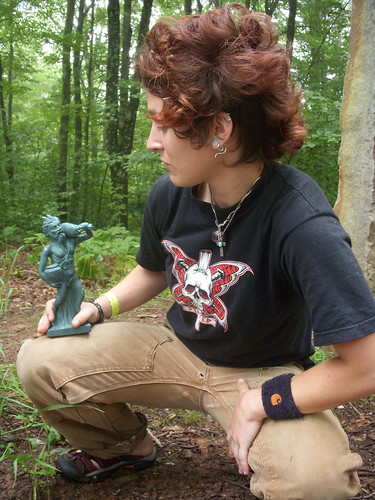
This is a picture of me and El Comandante at the stone circle at Four Quarters in Southern PA. An annual three-day hoof-stamping ritual takes places here the weekend of the summer solstice. Pan is ever-present at such dionysian celebrations, winking through the trees... but this time he graced us with a rare sort of presence...

Bless all of dem trickstars. Bless ya.

"A life without festivity is a long road without an inn."
-Democritus

Further reading (with primary source citations): Pan: Greek God of Shepherds & Flocks

Sunday, December 7, 2008

if nominator

The title of this blog post is an anagram of "information". As Anu Garg, the wizard behind wordsmith.org, says: "Anagrams never lie". (Giggle. I believe this is an exceedingly Hofstadterian statement!) :D

Various arts of word-changing to divine esoteric meaning abound in the occult, mystical and apocryphal teachings of all ages. Some essentially involve ciphering, as with gematria, where numerical values are assigned to different letters of the alphabet. Other methods of graph-o-mancy are more concerned with uncovering "hidden" connections within words that connect a word to other words, or transform the word into something else entirely. In Kabbalistic hermeneutics, temurah is one of three ways of meditating on text in scripture. It is essentially a mental exercise of anagram-generation with words in the Torah. But, before I digress further, let's apply this...

I take "if nominator" (a noun) to mean: A mechanism for revealing and proposing (nominating) options (or: if statements). This is, then, an esoteric meaning of "information".

This new word-form then indicates this:

Information should generate innovation.


Maybe I came off as giving "synthetic information" a hard time in my last post. I can't emphasize enough how important it is that we not occlude the true point. Since it's one of the theses of this blog that the world will be saved with an integrated combination of green things and informatics, it is my great pleasure to pontificate... in a discordian manner, of course! ;)

Information itself can not be demonized. It is not "good" or "bad", and its division by some (including me) into categories of "environmental" and "synthetic" or "organic" and "artificial", does not correspond to its value. In fact, such categorization is a rhetorical device - a program for thought, merely.

The point is this:

•Information must serve the people, NOT the corporations.
•It should be enabling and empowering, not controlling.

Antecedently, information should be free.

To further explore the imperative of us creators (artists, mad scientists and ecological designers alike) to properly deal with information, I want to evoke some wisdom from McKenzie Wark's book A Hacker Manifesto. (Salutations, brother!) Btw, please go find books this guy wrote, farmpunks... he's a master arranger-of-words & re-arranger-of-thought! To summarize a bit; In the opening chapter, he defines information as an abstraction of private property, which is itself an abstraction (of nature). Hackers are those who parse and recompile that information in order to create further abstraction: innovation. However, because of the nature of the hacker ethic to promote freedom-of-information and to end abuse of intellectual property, innovations generated by hackers are taken advantage of by the very group that hackers seek to disassociate themselves from. They are subordinated as a class in society by the 'ruling class' (financiers and CEOs) because the latter seek to turn novelty into profit.

In the last paragraph of the introductory chapter in the manifesto, he really captures what I've been trying to grok:

"The time is past due when hackers must come together with workers and farmers - with all the producers of the world - to liberate productive and inventive resources from the myth of scarcity. The time is past due for new forms of association to be created that can steer the world away from its destruction through commodified exploitation. The greatest hacks of our time may turn out to be forms of organizing free collective expression, so that from this time on, abstraction serves the people, rather than the people serving the ruling class."


Italics added.

Bless.